
As an Amazon Associate I earn from qualifying purchases.

Written by JJ Barnes
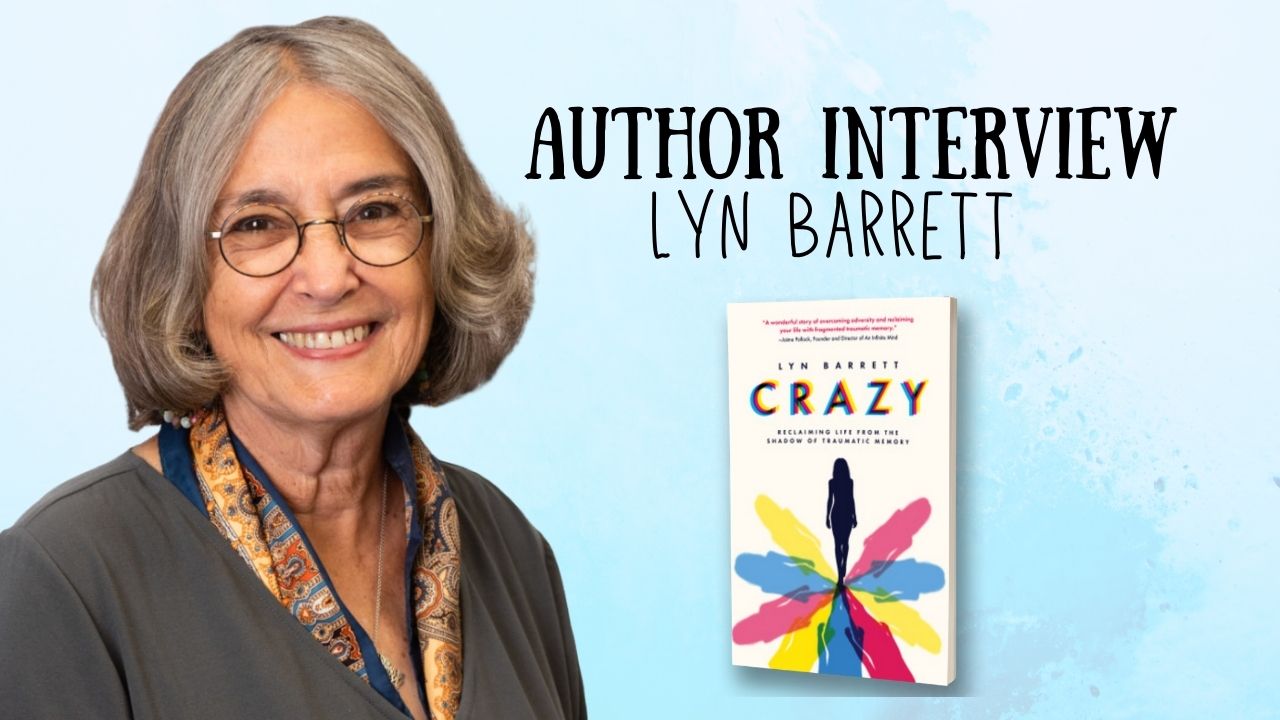
I interviewed author Lyn Barrett about her life, her experiences with Dissociative Identity Disorder, and why she felt inspired to write her memoir, Crazy: Reclaiming Life from the Shadow of Traumatic Memory.
Tell me a bit about who you are.
My name is Lyn Barrett and I’m the author of the memoir, Crazy: Reclaiming Life from the Shadow of Traumatic Memory, published in January 2022. A retired teacher, school principal, and pastor, I spend my time facilitating writers workshops for people with dissociative disorders, writing a weekly blog and newsletter, and hosting two websites.

I have four children, five grandchildren, and one great-grandchild scattered around the county. My husband and I live in the beautiful Adirondacks of New York but are in the process of relocating to the high desert of New Mexico.

When did you first WANT to write a book?
I’ve had an interesting but difficult life. In 1992, I was diagnosed with multiple personality disorder, now known as dissociative identity disorder (DID).
While I was decompensating, attempted suicide, and spent 30 days in a psychiatric hospital, I was also growing and excelling in my career as an educator, a very chaotic and disorienting experience.
After twenty years of deep inner work and another ten years bringing my professional life to a close, I began to think about retirement. I had been a good writer throughout my career and had lots of passions I cared about. “I should write a book,” I thought. Every time that went through my mind, a wall would rise up and I couldn’t think of anything to write about. “How odd,” I thought. “Writing should be my first thought, not my last thought.” Suddenly, I realized I couldn’t think about writing “any” book until I had written “the” book. I had to write about my life with DID.
When did you take a step to start writing?
I began writing Crazy the year before I retired in 2014. I dabbled in the writing but felt very committed toward producing something of substance. In the summer of 2016, I went to a week-long summer class on writing for healing. “Just up my alley,” I thought.
One assignment asked us to write about someone in our family. I wrote and shared a fairly benign piece about my father, but several members of the group were horrified that I might have negative feelings toward him (on Father’s Day, no less). Their response left me floored — especially in a class that purported to support healing. I was so triggered that I put my writing down and couldn’t look at it for three more years.
How long did it take you to complete your first book from the first idea to release?
With retirement firmly under my belt and more time to put that incident into perspective, I picked up my memoir again and started over from scratch in the winter of 2019. My husband and I went to Florida for four months each year and that became the place where I could really sink into the work.
When I returned home to the Adirondacks, I would spend very little time on it but in the winters of 2019 and 2020 — where the ocean waves soothed me and the sun baked me — I was a driven writer. I finished the first draft in April of 2020. Little did I know it would take ten more drafts, the review of several beta readers, and the wisdom of a topnotch editor before the book was ready for publication in the winter of 2021.
Then began the search for a publisher. My editor wanted me to go the traditional route because she thought Crazy could become a break-out DID book in mainstream publishing. However, I was 73 years old and had a specific purpose for the book in mind. I didn’t think I had the time or energy to wait several years to find an agent and publisher, so I chose, instead, a hybrid who ushered my book into the world of readership this year.
What made you want to write Crazy: Reclaiming Life from the Shadow of Traumatic Memory?
Without trauma-informed therapy, DID is a debilitating condition caused by chronic childhood trauma. I was relentless in my therapeutic process to heal the symptoms of abuse and address the complexities of DID. Happily, I reaped the fruits of my labor and, today, am a happy and whole person. Yet I remember how hopeless I felt when I was in the midst of my inner chaos, and I believe my story will be helpful for those in the same circumstances.

I wrote my memoir to be a beacon of hope for people with DID, their therapists, and their loved ones, and to educate the public about this disorder that is, contrary to popular opinion, not rare. According to research, between 1-3% of the population worldwide has DID as the body’s natural response to repeated childhood trauma.

What were your biggest challenges with writing Crazy: Reclaiming Life from the Shadow of Traumatic Memory?
For me, the biggest challenge was developing a platform in preparation for publication. I had no platform, so I was starting at ground zero. I was attending a writers workshop at the time when it occurred to me I could offer writers workshops for people with dissociative disorders.
What began as a self-serving initiative to build a platform turned into a truly awesome, organic movement of people who are yearning to share their writing, tell their stories, bond with others who understand, and find a safe space. I have been awed by the writers, the talent, the vulnerability, and the eagerness of our workshops. As a retired pastor, I experience this work as a ministry (although there is absolutely no religion involved).
Marketing is always a challenge, but I’ve found a way to turn it into a gift and a grace. Sometimes I wonder if the memoir is secondary to what I’m supposed to be doing. The real work happens in our workshops.
What was your research process for Crazy: Reclaiming Life from the Shadow of Traumatic Memory?
Memory is the underpinning of memoir. DID compromised my cognitive memory so digging up the context for the events I remembered was challenging. I relied heavily on boxes of journals I kept during that period of my life. Reading through every journal multiple times, locating the pieces I wanted to use, and re-remembering what had happened were the primary research tools I used.
How did you plan the structure of Crazy: Reclaiming Life from the Shadow of Traumatic Memory?
In the beginning, I made a simple outline that covered the chronology and events I wanted to include in the memoir. That served me well for my first draft. As I began to share it with beta readers, I listened to feedback that encouraged me to make some structural changes. For instance, I tagged my spiritual growth on at the end of the book and one reader said, “Lyn, this is such an important part of who you are. Do you think you might want to integrate it into the story chronologically?” Hmmm.
That led to printing out all my chapter headings and spreading them around the living room floor as I tried to figure out how to restructure the narrative. Somewhere between my tenth draft and employing my editor, I bought Scrivener and found it extremely useful to move sections from one part of the book to another. In the end, the structure began simply but developed in complexity organically over time.
Did you get support with editing, and how much editing did Crazy: Reclaiming Life from the Shadow of Traumatic Memory need?
I found a superb editor. She said, “Lyn, you’re a great writer. Now I’m going to show you how to tell a story.” A thorough developmental edit, mark-ups, a five page document of insights, and availability by email ensured we developed a strong working relationship. I took her suggestions seriously (though I didn’t agree with all of them 😊) and went to work revising my memoir, literally doubling its length. When I asked my editor to do a second run-through, she read it and said, “You’re the first person I’ve worked with who actually did what I suggested!”
What is the first piece of writing advice you would give to anyone inspired to write a book?
Just write. Worry about editing and revising later. Let the story come out, then get the feedback you need to make it better. But first, just write.
Can you give me a hint about any further books you’re planning to write?
Much to my own chagrin (I would like to really retire someday!), I have two books up my sleeve for the future. One is a meditation book for people with dissociative disorders inspired, in part, from my blog posts. The other is about forgiveness for people with dissociative disorders. There is a plethora of books on forgiveness, but none address the unique issues surrounding the horrific boundary-crossing of children that results in DID.
And, finally, are your proud of your accomplishment? Was it worth the effort?
Yes, I am proud of my accomplishment. My condition, DID, is endemic in families that foster secrets and lies. Sadly, at least one of my beloved family members is upset about the publication of my story and has put great distance between us. I grieve this. Yet it’s worth the effort. It’s worth the effort to come out of the closet. It’s worth the effort to tell the truth. It’s worth the effort to reveal family secrets that might, someday, be healed in the light. It’s worth the effort to, finally, be real.
Pop all your book, website and social media links here so the readers can find you:
https://www.facebook.com/lynbarrettbooks
https://www.instagram.com/lynbarrettauthor/?hl=en
Where to Buy:
We strive to keep The Table Read free for both our readers and our contributors. If you have enjoyed our work, please consider donating to help keep The Table Read going!
Amazon and the Amazon logo are trademarks of Amazon.com, Inc, or its affiliates.